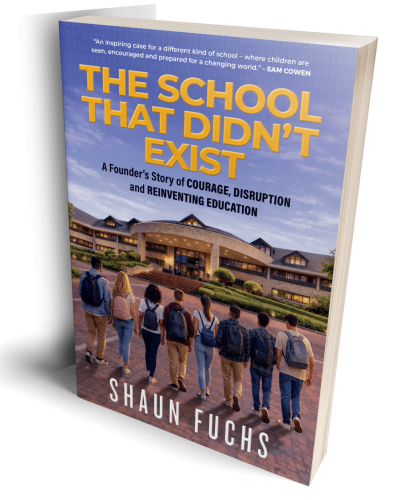
A Founder’s Story of COURAGE, DISRUPTION and REINVENTING EDUCATION

The creation of something new often begins with the deliberate dismantling of what no longer serves. In the case of one new school now changing the face of education in South Africa, it began during a pandemic with a man on a building site holding a high-pressure hose…
Shaun Fuchs was that man. The pandemic was Covid. And the building would become Centennial Schools in Sandton, Johannesburg. Despite overwhelming odds, Shaun knew his school would soon have a soul.
Gradually, the school began to take shape on a site that had once been an industrial office. It was still imperfect, still unfinished, but in that transformation, the building began to mirror the school’s philosophy: that spaces, like systems, can and should be redesigned. That purpose can be redefined. And that, with imagination, even the most unlikely foundations can support something entirely new.
The School That Didn’t Exist is both the story of the birth of Centennial Schools and a powerful manifesto for a new way to educate our children.
Inside the Book
Chapter 1: The Day the World Shifted
There was a moment when everything I thought I understood about education no longer made sense. Working in corporate education, I began to feel increasingly uncomfortable with how students and teachers were being reduced to numbers, targets and performance indicators. What began as quiet discomfort slowly became impossible to ignore. At the same time, the world itself was beginning to shift through the uncertainty of COVID-19. In that disruption, I started asking deeper questions about what schools had become, and what they perhaps needed to become instead.
Chapter 2: Starting Again at 50
Starting again was never part of the plan. At fifty two years old, after decades in education, I suddenly found myself without the certainty and structure I had always known. This chapter explores the emotional reality of standing in unfamiliar territory while the world around me was also changing rapidly. Through moments of reflection, travel and uncertainty, I began to realise that sometimes life forces you to stop long enough to reassess who you are and what truly matters.
Chapter 3: When Everything Falls Apart
COVID-19 stripped away everything that felt stable. Professionally and personally, it was a period marked by uncertainty, financial pressure and emotional exhaustion. Plans disappeared almost overnight, and many of the things Gordon and I had worked towards suddenly felt fragile. Yet in that collapse, I began to understand resilience differently. This chapter is about survival, perspective and the realisation that difficult seasons often reveal strengths and clarity that comfort never could.
Chapter 4: The Cost of Courage
Every decision to move forward came with consequences. Choosing to build something new without funding, guarantees or institutional backing created enormous pressure, both emotionally and financially. This chapter explores what courage really looks like when there is no applause, no certainty and no safety net. It reflects on the loneliness of leadership, the fear of failure and the discipline required to keep moving forward even when doubt feels overwhelming.
Chapter 5: Children of the Future
As the world around us changed, I became increasingly concerned that schools were still preparing students for a version of society that no longer existed. This chapter explores my growing conviction that education needed to evolve in response to technology, uncertainty and the changing nature of work and human interaction. I began questioning whether traditional systems truly encouraged curiosity, adaptability and independent thinking, or whether they were simply rewarding compliance and memorisation.
Chapter 6: The First Day
Opening Centennial Schools was both exhilarating and terrifying. After months of planning, construction and uncertainty, the vision finally became real. Yet beneath the excitement was a constant fear: what if nobody came? This chapter captures the emotional intensity of launching a school during an unpredictable period in history, while trying to create a culture and identity from nothing more than an idea and belief in a different approach to education.
Chapter 7: When the Dust Begins to Settle
Once the doors opened, the real learning began, and not just for the students. This chapter reflects on the gap between vision and implementation, and how quickly assumptions are tested in the real world. Building a school required constant adaptation, problem-solving and humility. It explores the lessons that emerged once the excitement faded and the daily realities of leadership, systems and people became more visible.
Chapter 8: After the Applause
The launch of a new school creates excitement, attention and momentum, but eventually the applause fades. This chapter explores what happens after the public moments pass and the responsibility of sustaining excellence begins. Leadership became less about inspiration and more about consistency, resilience and showing up every day. It reflects on the emotional discipline required to continue building when recognition disappears and expectations continue to grow.
Chapter 9: Building a Brand That Means Something
I came to realise that a meaningful brand is not built through slogans or advertising campaigns, but through lived experience. This chapter explores how Centennial Schools developed its identity through authenticity, trust and consistency. It examines the role of storytelling, social media and student culture in shaping perception, while also reflecting on the responsibility that comes with building a brand people genuinely believe in.
Chapter 10: A School Like No Other
Over time, I became increasingly sceptical of words like “innovation” and “different”, especially in education where those terms are often used without real substance behind them. This chapter explores my belief that true change comes from questioning the structures schools have accepted for decades. From classrooms and timetables to authority and assessment, I began challenging assumptions that many people simply take for granted.
Chapter 11: Building From the Top Down
What I realised through this journey is that culture always begins with leadership. The standards, expectations and behaviours within a school are shaped by the people leading it. This chapter reflects on the responsibility of leadership, especially when building something from the ground up. It explores the importance of trust, accountability, decision-making and creating an environment where people feel both supported and challenged to grow.
Chapter 12: Built for Curiosity
I wanted to create a school where curiosity was not treated as a distraction, but as the foundation of learning itself. This chapter explores how the physical spaces, teaching approaches and systems within Centennial Schools were intentionally designed to encourage questioning, creativity and independent thinking. It also reflects on the balance between structure and freedom, and why genuine learning often begins when students are trusted to think for themselves.
Chapter 13: The Future Is Already Here
As technology and artificial intelligence began reshaping society, I was forced to confront difficult questions about the future of education. This chapter explores the opportunities and risks that AI presents, while arguing that schools must focus less on information delivery and more on developing judgement, critical thinking and adaptability. Rather than fearing technology, I believe schools must help students learn how to think alongside it without losing their humanity.
Chapter 14: Full Circle
Looking back, the journey feels both improbable and inevitable. What began as uncertainty, disruption and risk ultimately became something far bigger than I could have imagined. This final chapter reflects on legacy, perspective and the meaning behind building something that once did not exist. More than anything, it is about understanding that the most important journeys often begin long before we fully recognise where they are leading us.